Pages

Showing posts with label Nikon. Show all posts

Wednesday, May 1, 2013

Nikon Coolpix A in Action: Photos, Tips and Thoughts

After the previous post, I think everybody more or less knows how Nikon Coolpix A looks like. However, the photo quality is always the top factor to evaluate a camera's capability. In this post, I will share some of my photos taken by the camera and also my experience of using it. 

I have never used a Nikon camera before, be it compact or DSLR. It took me some time to get familiar with the controls and settings, but it isn't too long. Most of them are intuitive. I said MOST is because there are still some quirky settings I don't really appreciate. For example, the dial on the top right is set default as aperture dial. It can change ISO and exposure compensation, as well, by pressing the ISO or exposure compensation button. But I have to hold the button while adjusting the ISO or EV. This eventually makes me have to use two hands to operate the camera.

With the APS-C sensor, Coolpix A undoubtedly has superior image quality compared to a normal compact camera. Most of compact cameras nowadays are able to produce good photos under sunlight. The real challenge is the performance in low light. So noise level at high ISO is crucial. Coolpix A manages the noise pretty well, personally I feel that the maximal working ISO is 3200. 

DSC 0001

This photo was taken in the sunrise, outside my window. F5.6, 1/250s, ISO 110 using scene mode.
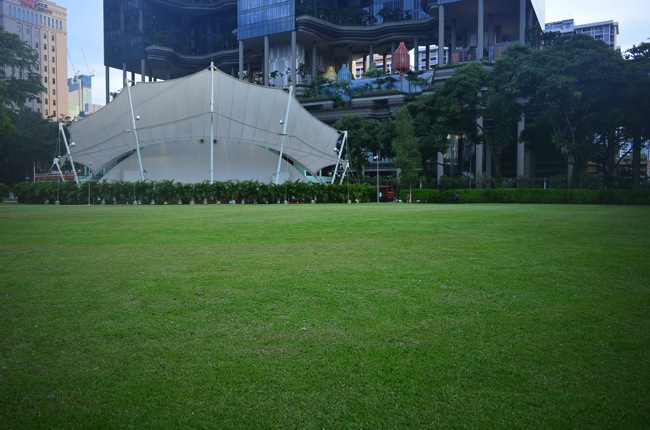
DSC 0006

After work, passing by Hong Lim Park. F4, 1/125s ISO 220, using scene mode.

DSC 0019

Boy playing with water at Bugis Junction. F4, 1/640s, ISO 200.

DSC 0033

Black Glutinous Rice at Ah Chew Dessert. F2.8, 1/30s, ISO 1600.

DSC 0042

Kids playing on the beach at Sentosa. F5.6, 1/400s, ISO 100.

DSC 0043

Macro shot of flower. F5.0, 1/30s, ISO 640.

DSC 0007

Chicken wings at Over Easy bar. The actual scene is even darker than the photo. F2.8, 1/15s, ISO 2500

DSC 0014

Close-up shot of apple cider. F2.8, 1/20s ISO 3200.

Verdict

Some of my thoughts on Coolpix A, good and bad.

Good:

1. Small and light, it is one of the few that I am willing to carry on a daily basis. The compact body also makes it easier to snap street photos without drawing too much attention. 

2. High ISO performance is pretty impressive, thanks to its APS-C sized sensor. 

3. 28mm focal length is suitable for various scenarios, so I don't find the fixed length that inconvenient.

4. Battery seems pretty good, around 200 photos per charge. Considering it is small in size and APS-C sensor is definitely more power consuming than the compact camera sensor.

5. Though Coolpix A does not support Wi-Fi and GPS in camera, it's worth mentioning that its accessories can enable it for that. Of course that needs to be purchased separately.

Bad:

1. F2.8 is fast, but not fast enough. In some extreme condition, F2.8 is still too small an aperture, which leads to slow shutter speed and hand-shake.

2. High ISO performance is a bonus point for Nikon Coolpix A. Since F2.8 is not sufficient, I turn to higher ISO. I find it more useful when I set the ISO to AUTO. However, the auto ISO option is not even in ISO setting. I have to go a few levels down and finally find it buried in the camera settings.

3. Image could be sharper, especially at F2.8. There is also some vignetting and loss of details at the corners.

4. Camera lacks built in HDR which may disappoint some users like me.

5. Price tag could be too high. It is even more expensive than some entry level DSLR. Even compared to the same category, such as Fujifilm's X100s, it is around the same price but seems offering more features. However, that depends on individual's needs and preferences.

In all, if you are looking for a compact, low profile camera which can produce excellent images, I would recommend you to take this camera in consideration. It is not much bigger than a smartphone so that you can literally slip it in the pocket.  28mm lens is good for most hangout or walkabout. Impressive high ISO performance makes indoor photo shooting much easier. 

Technorati Tags: , , ,

Monday, April 29, 2013

Pocket-size Camera, Professional Quality: Nikon Coolpix A Hands-On

Camera market in 2013 has been heated by many mirror-less cameras with smaller size yet professional image quality. The combination of APS-C sized sensor and fixed focal length has been popular across different brands: Sigma DP1M, Fujifilm X100s, Ricoh GR, etc. And now it's Nikon's time! Coolpix A is Nikon's latest product that brings APS-C sensor in a compact camera body. It comes with fixed length of 18.5mm (35mm equivalent: 28mm) and its largest aperture is F2.8. In this post, I will have a brief hands-on about how this camera feels.

DSC07419

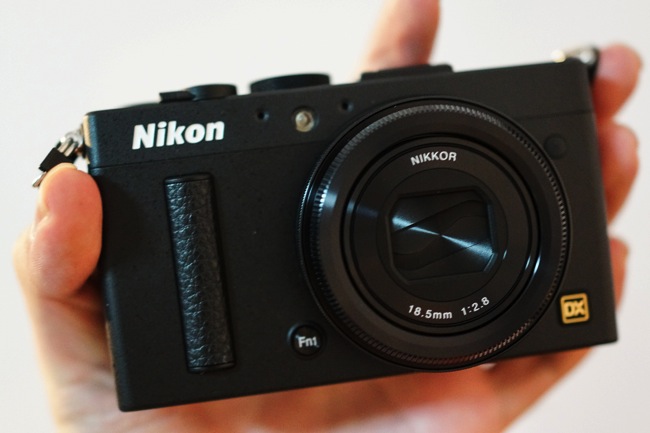
As the name suggests, Coolpix A is in Nikon's Coolpix series, which is designed as a very compact camera body. The black paint is somewhat similar to that on Nikon's DSLR line. It has a special finish with some visible texture. There is a slight curved, leather covered grip at the front to increase the comfort level when people hold the camera. The lens, like many point-and-shoot camera, is covered by the curtain that is controlled by the power switch. There is also an Fn1 button next to the lens.

DSC07018

Compared to Sony RX1, it is shorter and narrower. With less prominent lens size, it is also smaller in depth. It is very light-weighted, 299g, around two smartphones' weight.


 DSC07425

My palm is not big, but I still manage to grab Coolpix A in one hand. It can be easily slotted in a casual outing bag without much effort. People usually will not notice that it is something different from their point-and-shoot camera by just looking at the camera size.

DSC07436

On the back of Coolpix A, the control layout is very much like that on Nikon's DSLR, which is good for previous Nikon's DSLR users. However, I feel that the buttons on the left are somewhat crammed at the edge. Imagine holding the camera in one hand, it is difficult to press the button on the left side, no matter using left or right hand.

DSC07432

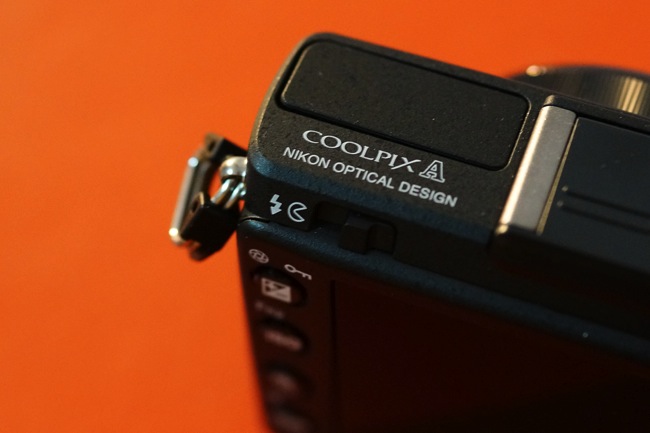
On the top left, it's the Coolpix A print and the flash is hidden in the plate. And this may appeal to some buyers: made in Japan!

So far I feel that Coolpix A is very convenient for carrying around: it can be fit in my suitcase easily and 28mm equivalent focal length is versatile in most cases. I will share more about the shooting experience with Nikon Coolpix A in the next post.  

Technorati Tags: , , ,

Wednesday, March 27, 2013

Guest Blog: Nikon Full Frame DSLR D600 Review: Part II

By TJ Xie

It’s been more than three weeks since I got my D600. I have been trying to explore its potential as much as I can. Lenses I use are 50mm f/1.8G, 85mm f/1.8G, 105mm f/2.8G Micro and Voigtlander 28mm f/2.8.

In this part of review, I will talk about the high ISO performance and show some sample pictures.

Before we start, here’s a summary of my experience with D600:

1. Auto ISO setting is fantastic

2. Higher shutter speed is needed to obtain sharp images

High ISO performance

High ISO performance does not rely solely on the camera itself. Instead, the lighting condition under which photos are taken matters more. In other words, under a low-light condition, photos contains more noise than those taken in bright lighting. As such, I thought a favourable place to test out the high ISO performance would probably be a museum where lights are dimmed. Then, I decided to visit the ArtScience Museum. There is an ongoing Lego exhibition named “Art of the Bricks”.

A bit of sidetrack on my camera’s settings. I set my camera to auto-ISO mode so that in aperture priority mode, the ISO value increases automatically when I need a slower shutter than a minimum speed of my choice. A nice feature I found on D600 is that the camera is able to set a minimum shutter speed automatically. By default, the minimum shutter speed is set to the reciprocal of the focal length of the lens. For example, if I mounted a 50mm lens on the camera, the minimum shutter speed would be 1/50s. If I change the lens to a 85mm, the minimum shutter speed changes to 1/100 accordingly. In the past, I often forgot to change the minimum shutter speed when I changed a lens. This feature solves my problem.

As expected, the lighting was poor in the museum. Many of the shots turn out to have high ISO values. Here are some pictures with high ISO values:

ISO 1600

NewImage

http://tjxie.smugmug.com/photos/i-LDTrvRR/0/X3/i-LDTrvRR-X3.jpg

ISO 3200

NewImage

http://tjxie.smugmug.com/photos/i-cTWDGbd/0/X3/i-cTWDGbd-X3.jpg

ISO 4000

NewImage

http://tjxie.smugmug.com/photos/i-WBHCdj5/0/X3/i-WBHCdj5-X3.jpg

The noise level is not visible by 3200. To me, even the last picture with ISO 4000 is acceptable. I shoot in RAW, and sharpness is always my priority, so I wouldn’t mind pushing the ISO all the way up to 6400 in order to get sharp images. And I will leave noise reduction work to my computer

Macro and walkabout

On the other day, I went for a walk in Singapore Botanic Gardens. The shots are mainly macro and walkabout photos.
For macro photos, because of the long focal length of 105mm, I was forced to use apertures smaller than f/8 to ensure sufficient depth of field. As I have described in Part I of the review, when the aperture gets smaller, the dust/oil spots becomes more obvious on the photo. However, since I’ve bought the camera, other than waiting for a solution from Nikon, I would rather find out my own solution. After a few clicks with the auto-retouch tool in Capture NX 2, the spots are not visible anymore. Here are some sample pictures for you to enjoy.

NewImage

NewImage

NewImage

NewImage 


Issue

One annoying issue I have with D600 is that, when I set the camera to auto-ISO mode with the default minimum shutter speed, it appears that this shutter speed is not fast enough to prevent hand movements. This is not strange because with such a high resolution, small movements are likely to get exaggerated when the photos are zoomed in to 100%.

Again, I need my own solution. I would set the minimum shutter speed one stop faster in the outdoors or when the lighting condition is good, i.e, 1/100s for a 50mm lens. Thanks to the good high ISO perfornace, I have the luxury for the ISO value to automatically increase by one stop to compensate the exposure. Photos are now less prone to hand movements with the faster shutter speed.

Verdict

It’s a great camera. I’ve not used D800 or D4, but for SGD2400, I thought I've got a good camera. I like it when my 85mm portrait lens is no longer so tight during framing, and when my 28mm Voigtlander is literally a wide angle lens now. The ISO performance is also a lot better than my previous D90. The only issue would be the occassional blurry images caused by the high resolution, but it can be avoided by using higher shutter speed.

Some people are still concerned about the dust/oil spot issue. My suggestion would be that if you mainly shoot portraits or landscapes which don't require a small aperture (if you understand hyperfocal distance, an aperture smaller than f/8 does't give you much more depth of field on a wide angle lens), this issue would be a non issue. The only scenario where this issue matters would be the macro photography. However, it can be solved easily.

Technorati Tags: , , , , ,

Wednesday, March 13, 2013

Guest Blog: Nikon Full Frame DSLR D600 Review: Part I

By TJ Xie

NewImage

Why D600?

Photography is a hobby of mine. I shoot landscapes, events and street photography. There were a few constraints I had with my 3-year-old Nikon D90:

1) the 11-point focus system was too spread out for focus tracking;

2) the poor high ISO performance beyond ISO 1600 and;

3) zoom lenses are too heavy when I go travelling.